
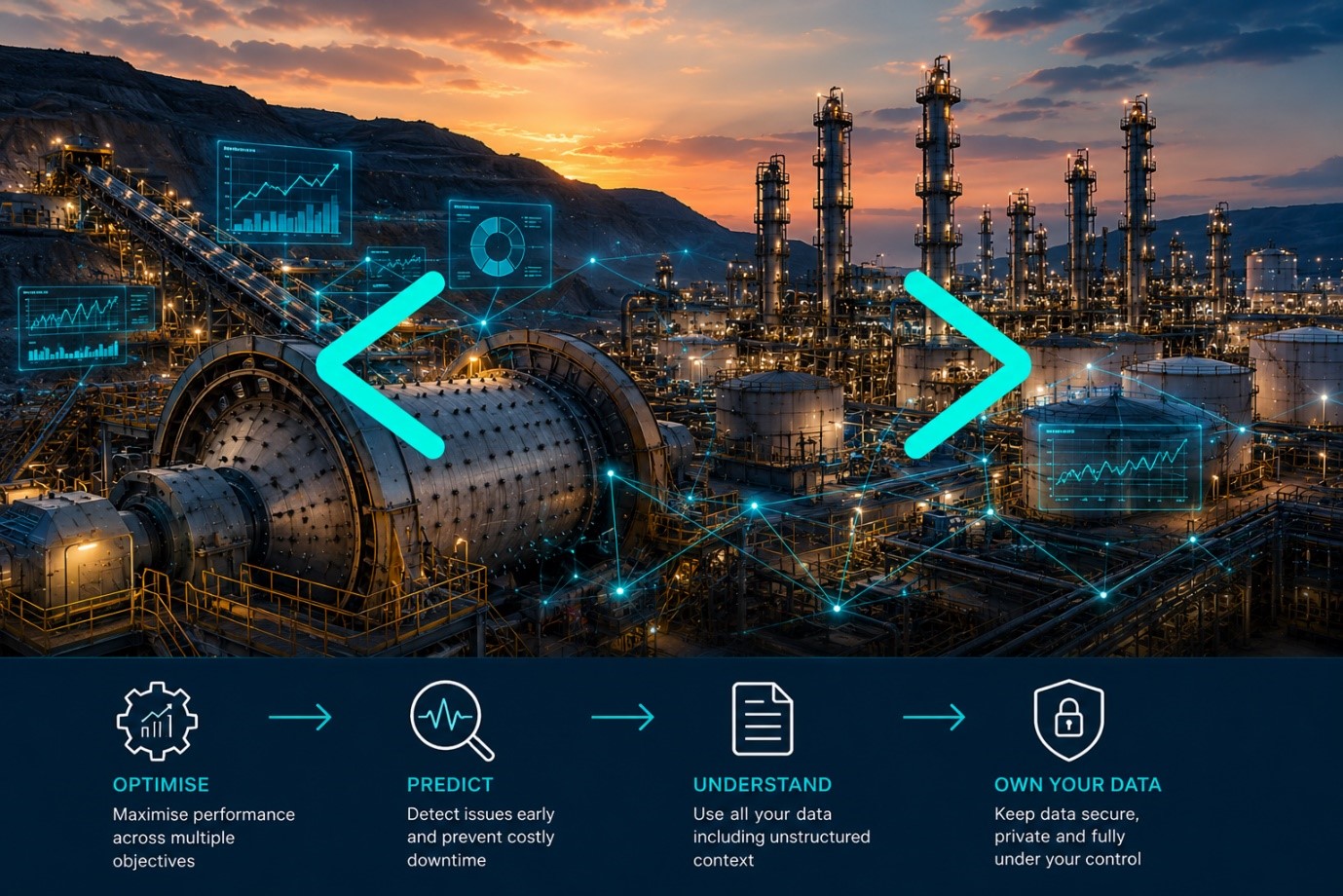
How machine learning can connect process performance, predictive maintenance and the knowledge already contained within your business.
Industrial operations have never had more data available to them.
Mining operations, mineral processing plants, oil and gas facilities and other resource industries continuously generate information from sensors, control systems, laboratory measurements, maintenance records and operator observations. Yet having more data does not necessarily mean making better decisions.
The opportunity for machine learning is not simply to produce another dashboard or report. It is to turn this information into better operational decisions — and increasingly, to connect those decisions across the entire operation.
1. Start with the process: optimise what you are trying to achieve
Industrial processes rarely have a single objective.
A SAG mill, for example, may need to maximise throughput while operating within limits on mill speed, power, feed characteristics and equipment condition. An oil production process may need to maximise production while simultaneously managing vibration, water, solids or other constraints.
This is where machine learning can move beyond simply predicting what will happen.
Instead of asking “What happened?”, the more valuable question becomes:
“Given the current conditions, what should we do?”
A machine-learning optimisation system can learn the relationships between thousands of variables and identify operating conditions that best balance multiple objectives. The result can be a recommended set-point or operating state — not just a prediction.
This approach is already applicable to areas such as SAG mill optimisation, mineral processing and oil production. For example, our Prophyt platform optimises multiple target objectives simultaneously and provides recommendations in line with business utility measures and operational constraints.
But there is an important next step.
2. Don’t optimise the machine at the expense of the machine
The highest production rate is not necessarily the best operating point.
A process may be capable of producing more today, but doing so could increase vibration, accelerate wear or move critical equipment closer to failure. Conversely, reducing operating intensity may protect an asset but unnecessarily sacrifice production.
True industrial optimisation needs to understand both sides of this equation.
Machine learning can therefore incorporate equipment condition as one of the objectives or constraints alongside throughput, yield, quality, energy efficiency or profitability.
The question becomes:
How do we get the most from the process while keeping the equipment within an acceptable operating envelope?
This creates a natural bridge from process optimisation to predictive maintenance.
3. From “what should we do?” to “what is going to happen?”
Equipment failures rarely appear without warning.
Changes in vibration, temperature, pressure, current, flow and other operating signals can contain subtle indications that equipment behaviour is changing. The challenge is recognising those patterns early enough to act.
Predictive maintenance uses machine learning to detect deviations from normal behaviour, identify patterns associated with developing problems and provide an earlier indication of potential failure.
That can change maintenance from a largely reactive activity into a more informed decision-making process:
Detect → understand → predict → prioritise → act.
For critical equipment, the value can be substantial. The objective is not simply to predict that something is wrong, but to understand what is changing, why it matters and when intervention may be required. This is the type of workflow enabled by our Predictive Maintenance product.
4. The data you need isn’t all numerical
There is another source of industrial intelligence that is often overlooked: the information people have already written down.
Maintenance notes, inspection reports, shift handovers, incident reports, engineering documents and process notes can contain valuable context that cannot be found in a sensor stream alone.
Combining this unstructured information with telemetry and historical process data can give machine-learning systems a much richer understanding of why an asset behaves differently or what has happened previously under similar conditions.
This is where retrieval and Generative AI can become particularly useful — not as a replacement for industrial analytics, but as another layer of context around it.
5. Your industrial intelligence should belong to you
For many organisations, this raises an equally important question: where does all of this data go?
Industrial data can contain commercially sensitive information about production, equipment performance, processes and operational history. Building an AI capability around external APIs may be convenient, but it can also introduce ongoing usage costs, external data dependencies and questions around where sensitive information is processed.
There is a compelling alternative: deploy the intelligence within the organisation’s own environment.
With modern open-source Generative AI models, businesses can build retrieval and analytical systems that operate locally, integrate with their own databases and documents, and continue operating without an internet connection after installation.
That means the business can retain control of its data, avoid ongoing token costs and customise the system around its own processes and knowledge.
And this distinction matters.
As AI becomes easier to package through APIs, it is increasingly important to distinguish between using AI tools and engineering an AI capability around the realities of an industrial business. A serious industrial AI solution should ultimately be capable of working with the organisation’s own data, infrastructure and operational requirements — rather than making the business permanently dependent on someone else’s API.
A more complete view of industrial AI
The real opportunity is therefore not a single AI model or application.
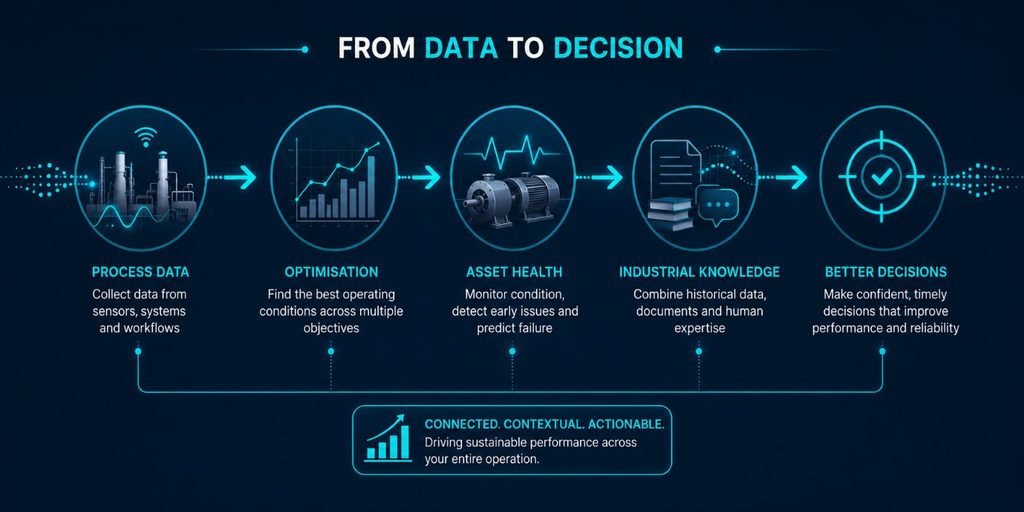
It is the connection between:
Optimisation — What should we do to improve performance?
Predictive Maintenance — What is likely to happen to the equipment?
Industrial Knowledge — What does our historical and human knowledge tell us?
Together, these create a more complete picture of the operation.
At September AI, this is the direction behind three complementary capabilities: Prophyt for multi-objective industrial optimisation, Predictive Maintenance and Insight Nexus for working with the organisation’s own unstructured information and knowledge.
The technology is important, but the starting point should always be the industrial problem.
Where is performance being lost? Which assets create the greatest risk? What information is currently inaccessible? And which decisions could be improved if all of that knowledge could be brought together?
With more than a decade of experience applying machine learning to industrial problems, we believe the most valuable AI solutions are those that work within the realities of the operation — using the data, equipment and knowledge that businesses already own.
If you are exploring where machine learning could make a measurable difference in your operation, we are always happy to discuss the problem first — and the technology second.